
Hot desking lets several people share one desk phone, or lets people sit at any desk and take their calls on the phone in front of them. You sign in to a shared phone with *31 and sign out with *32.
Before you start
These points are for Office Managers and IT administrators setting up hot desking.
- Hot desking can’t be used together with Call Center features.
- A phone used for hot desking should not belong to a specific person.
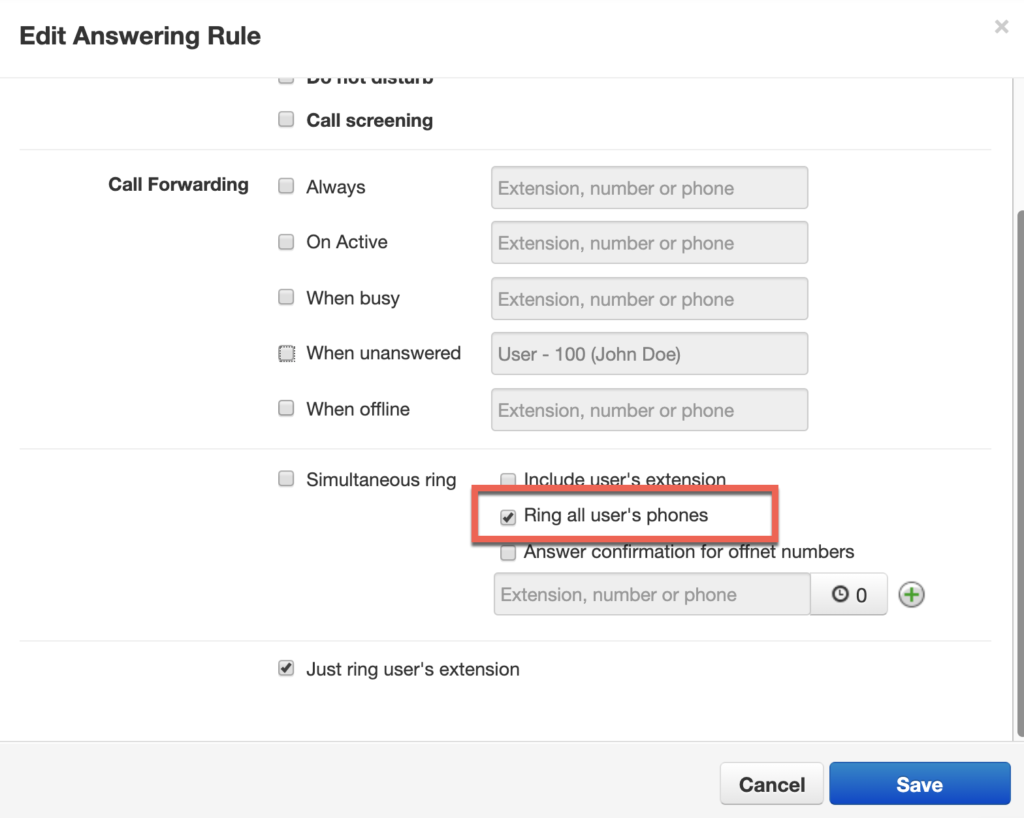
- Hot desking only changes the Default answering rule, and Ring all user’s phones must stay turned on. If another answering rule is placed above the Default rule, hot desking won’t apply to calls.
- To receive calls at a shared desk, a user must sign in to that phone. The phone is then linked to them, their calls ring there automatically, and their call statistics follow them.
Phone settings for hot desking (IT administrators)
Turn off feature sync on phones used for hot desking, because it causes call routing problems. Use these overrides:
- Yealink: bw.feature_key_sync=”0″
- Polycom: voIpProt.SIP.serverFeatureControl.cf=”0″ voIpProt.SIP.serverFeatureControl.dnd=”0″ voIpProt.SIP.serverFeatureControl.localProcessing.dnd=”0″
Set up hot desking
Create a user for each person who will hot desk, and a user for each shared phone location. Remember: a phone used for hot desking should not belong to a specific person.
Example extensions
| User | Extension |
|---|---|
| John Doe | 100 |
| Jane Doe | 101 |
| Receptionist Phone | 200 |
In this example, users 100 and 101 should have user extensions only, with no phone (device) assigned. Extension 200 should have both a user and a phone. Users 100 and 101 sign in to and out of the phone at extension 200.
How hot desking works
- Signing in (*31) makes the shared phone yours. Your calls ring on it (it is added to your simultaneous ring), and whoever was signed in before is signed out.
- Signing out (*32) gives the phone back to its original owner (extension 200 in the example).
Sign in to a shared phone (*31)
- From the shared phone (extension 200 in the example), dial *31.
- When prompted, enter your extension number (for example, 100).
- When prompted, enter your voicemail PIN, followed by #.
- You’ll hear who is currently signed in to the phone. Press 2 to take over the phone.
- You’ll hear a confirmation that you are now signed in to the phone.
Sign out of a shared phone (*32)
- From the shared phone (extension 200), dial *32.
- When prompted, enter your voicemail PIN, followed by #.
Note: You don’t have to sign out before someone else uses the phone. If Jane Doe signs in to extension 200, John Doe is signed out automatically.
Common questions
What if someone forgets to sign out before the next person signs in?
Their calls keep ringing on that phone until someone else signs in to it or they sign in to a different phone. Either one signs them out of the first phone.
How do I route calls to someone who hot desks?
Route calls to the person’s user extension (for example, 100), not to a phone. If they aren’t signed in to a phone, unanswered calls go to their voicemail.
My phone extension disappeared while I was hot desking
Tip: As a best practice, people who hot desk should not have their own phone (device) assigned.
It wasn’t deleted. A user can only have one phone at a time, so when user 100 signed in to the phone at extension 200, the system released their own phone (100). When user 100 signs back in on their own phone, extension 100 reappears in the portal.
How does the simultaneous ring answering rule work?
Important: Simultaneous ring for hot desking always uses the Default answering rule.
Keep Ring all user’s phones turned on. Turning it off stops hot desking from working properly. When you sign in to a shared phone, that phone is linked to your user profile and automatically added to your simultaneous ring.
How does billing work for hot desking?
You are billed for phones (devices) assigned to users. If the people who hot desk have no other phones assigned (as recommended), hot desking doesn’t add any seat charges.